FLOOD INUNDATION MAP TRAINING – NOAA, Burlington
NOAA’s new on-line predictive flood model available for local officials.
To view the local presentation, click here.
Presentation Handout | Fact Sheet | Access Instructions | Quick Start How-To Guide
2025 DROUGHT RESOURCES
VT Drought Resources, VT Agency of Natural Resources
Drought Disaster Response and Recovery Resources, VT Agency of Ag, Food and Markets
2025 VT Agriculture Drought Impact Survey, VT Agency of Ag, Food and Markets
Drought and Your Well, VT Department of Health
Current Lake Champlain Level at Rouses Point, NY, NOAA
VT Fire Danger Forecast, VT Forests, Parks and Recreation
Vermont’s 2025 Drought and Cover Cropping: Stay the Course , UVM Farm Extension
Northeast Drought Update, Northeast Regional Climate Center, Cornell University
US Drought Monitor, National Drought Mitigation Center, University of Nebraska, NOAA, USDA, USDOC
FLOOD DAMAGE REPORTING
Homeowners
Any homeowners with needs and/or damaged infrastructure should call into 211.
Vermont 211 – United Way — VT 211
Those numbers are 866-652-4636 or 802-652-4636. These lines may be busy, but it is crucial to continue to dial in.
This information collected is important in determining other Federal funding needs.
Local public officials, state agencies, and critical Private Non-Profits (fire/police/medical)
Below are key points to remember to begin the recovery process from damages which could result in a potential federal declaration which provides funding for recovery. Federal financial recovery assistance may be available under the FEMA Public Assistance program for local road repairs/culverts/debris and emergency response.
FEMA Public Assistance covers damage to applicant owned and maintained facilities. A facility must be a public building, public works system, public equipment, or natural feature. It does not cover private property (homes). If you have residents asking about residential damages, please ask them to report their damages to 211.
For any public town damages:
- Prior to beginning work. Take a few photos to provide the details of the damage. Ensure these photos show the entire damaged site.
- Mark the GPS location of the site associated with the damage. Provide the GPS starting and ending point of the damages.
- Capture the “Length x Width x Depth” measurements in feet and quantities of material used per site.
- Contract work should be hired following your Local and Federal procurement policy requirements.
- Track your recovery costs per damaged site.
- When working in/near waterways, obtain an ANR Stream Alteration permits. Also check the Army Corps of Engineer (USACE) permits. Reach out to your ANR River Engineer to obtain these and ensure that you are complying with State General Stream Alteration standards for any in-stream repairs.
- For repair work taking place, track who is working at the site and keep all Labor timecards with hours worked per location.
- Maintain and track quantities of materials used and invoices for costs or load tickets (gravel, culverts), by site.
- Track the equipment used for repair work and operator hours, by site.
Stay safe and reach out to Kim Canarecci, Vermont State Public Assistance Officer 802-585-4209.
___________________________________________________________
General Information any time your community is impacted by a disaster.
People, organizations and municipalities should document damage before any repairs through photos. Keep copies of all invoices and receipts, and report damage promptly.
Municipalities can report damages to the state through NRPC. We will reach out to you, but if you do not hear from us, please contact our office (802-524-5958 x113. We will relay information to the state.
NRPC works closely with the Vermont Agency of Transportation Maintenance District offices to assist towns regarding transportation infrastructure. You may call them directly, or we will relay your information to them.
Vermont Agency of Transportation maintains an updated map of state road closures for prolonged events.
Any recovery work in or next to streams needs to be coordinated with your respective ANR river engineer and you can find their regular and emergency permitting here.
The Vermont League of Cities and Towns has a series of helpful links for Preparedness, Response & Recovery for towns.
The Vermont Municipal Flood Guide was created to assist all types of Vermont town officials, boards, staff, volunteers and others, with considerations and resources related to flooding disasters.
Floods create a variety of safety hazards. The Vermont Department of Health has a wealth of information on flood safety.
Individuals with flooding issues should contact their municipal emergency services office. People can always call 2-1-1 for the latest information.
And never drive through flood waters – Turn Around, Don’t Drown!
July Flood 2024 Resource & Information Links
Vermont Emergency Management Flood Resources and FAQs
Agency of Commerce and Community Development – Severe Storm Resource Center
Vermont League of Cities and Towns – Flood Recovery Resources
Agency of Natural Resources Flood Recovery
Agency of Ag Food and Markets
USDA Natural Resources Conservation Service – Emergency Watershed Protection Program
Vermont Emergency Management Public Assistance Funding
Official Vermont Volunteer Registration Site
Vermont Department of Health Flood Safety Resources
Agency of Transportation State Road Closures Map
Agency of Natural Resources Boil Water List
Vermont 211 – United Ways of Vermont
Community Action Champlain Valley Office of Economic Opportunity – St. Albans
Vermont Flood Response and Recovery Fund
Northern New England Red Cross
United Way of Northwest Vermont
Flooding Safety Advice in 16 Languages
Emergency Management
There are two main categories of disasters: natural, which are flooding, severe storms, health pandemics, etc.; and human-caused, which are chemical spills, active shooters, train derailments, water main breaks, etc.
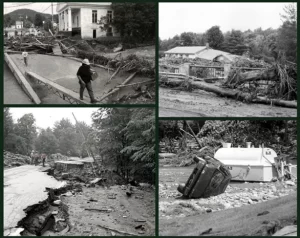 Each type of disaster or event goes through the same basic cycle:
-
-
Event: Something bad happens.
-
Response: Efforts to save lives and minimize property damage, and efforts to make the bad stuff stop, if possible.
-
Recovery: Getting life back to normal.
-
Mitigation: Actions that are taken to reduce or eliminate long-term risks to people and property from this event, should it happen again.
-
Planning and Preparedness: Determining how to improve response for the next time around, and ensuring that the improved tools to do so are in place.
-
NRPC focuses mainly on planning and mitigation with communities. NRPC also supports local communities during response and recovery during larger-scale events. This means we work with communities to identify vulnerabilities and then prioritize actions to eliminate or lessen the risk. It means arming people with information and training opportunities and providing platforms for information to be shared. It means creating opportunities to test and practice emergency plans. It means being a resource for towns so that the Northwest region can be stronger and more resilient.
Local Emergency Directors and Coordinators
Local Emergency Management Directors, EMDs, and Coordinators, EMCs, play an important role in their communities—it’s also a state law that each municipality have an Emergency Management Director or Coordinator. The role of EMD defaults to the town’s executive officer if an EMD or EMC is not appointed.
EMDs and EMCs oversee and spearhead planning and preparedness activities for their community, usually in coordination with the town manager or select board. During emergencies, EMDs and Cs are a critical link between the town and the outside world.
NRPC understands that most EMDs and Cs are volunteers with many other responsibilities and obligations. We will work with you and your community leaders to identify and prioritize actions that make sense for your town. We’ll provide you with tools, templates, and expertise along the way.
Vermont’ Emergency Management Directors Manual is located here.
For information on Vermont’s Emergency Management Certification Program, click here.
Local Emergency Management Plan
Local Emergency Management Plans (LEMPs) are the most basic planning and preparedness tool for municipalities. The state requires each municipality to complete, adopt, and submit LEMPs annually after Town Meeting and before May 1. An electronic template is available on Vermont Emergency Management’s website or by contacting NRPC. It’s important to carefully review the LEMP each year. Email addresses, phone numbers, and sites to be checked are all likely to change over time.
For more information on LEMPs including templates, click here.
Continuity of Operations Plan
A Continuity of Operations Plan (COOP) addresses how municipalities will continue to operate under a broad range of circumstances. COOP is important as a good business practice because the planning fosters recovery during emergency situations. A COOP addresses emergencies from an all-hazards approach. It establishes policy and guidance ensuring that critical functions continue and that personnel and resources are relocated to an alternate facility in case of emergencies. The plan should develop procedures for: alerting, notifying, activating and deploying employees; identify critical business functions; establish an alternate work facility; roster personnel with authority and knowledge of functions. COOP may be added as an annex to your Local Emergency Management Plan.
To view/download a COOP template, click here.
Additionally, a Business Continuity of Planning Workshop Video, information and materials are located here. The workshop was held as part of the Northern Vermont Economic Development District Resiliency Project in the fall of 2025.
Local Hazard Mitigation Plans
Mitigation is any action that reduces or eliminates long-term risks to people and property from disasters.
A hazard mitigation plan (HMP) is a community’s strategic blueprint for reducing long-term risks from natural or human-caused disasters, identifies local hazards and risks and prioritizes actions to lessen potential damage. By identifying risks in advance and investing in targeted solutions—like strengthening infrastructure, revising land-use policies, or improving emergency communications—an HMP helps protect lives and property, reduces recovery costs, and supports faster, more resilient recovery when disasters occur. LHMPs must be adopted by the municipality and approved by the state and by FEMA every five years. Having an LHMP makes municipalities eligible for mitigation grants such as the Hazard Mitigation Grant Program and Flood Mitigation Assistance Program.
In Vermont, having an HMP also makes a community eligible for a reduced local match for emergency repairs following a Presidentially Declared Disaster. See Vermont’s Emergency Relief Fund (ERAF) website for further information.
South hero VT Hazard Mitigation Plan 2026 – Public Comment
The town of South Hero is seeking public comments on the update to the Town of South Hero Local Hazard Mitigation Plan 2026.
The plan is available here. Hard copies are available by request and at the South Hero Town Office, 333 US Route 2, South Hero, VT 05486 or by mail by request.
The Public Comment period will end on October 16, 2026 at 4:00 p.m. To request a copy or submit written comments by email: SColeman@nrpcvt.com or by mail to: NRPC, 75 Fairfield Street, St. Albans, VT 05478 or by phone at (802)524-5958 ext. 113.
HIGHGATE VT Hazard Mitigation Plan 2026 – Public Comment
The town of Highgate is seeking public comments on the update to the Town of Highgate, VT Local Hazard Mitigation Plan 2026.
The plan is available here. Hard copies are available by request and at the Highgate Town Office, 2996 VT Route 78, Highgate Center, VT 05459 or by mail by request.
The Public Comment period will end on October 14, 2026 at 4:00 p.m. To request a copy or submit written comments by email: SColeman@nrpcvt.com or by mail to: NRPC, 75 Fairfield Street, St. Albans, VT 05478 or by phone at (802)524-5958 ext. 113.
Regional Emergency Management Committees
The REMCs were established by statute under 20 V.S.A. § 6(d), to support coordinated emergency planning efforts within “regions”. NRPC is supporting the two REMCs for Franklin and Grand Isle County in partnership with Vermont Emergency Management.
Membership: REMC voting members will consist of 2 members from each municipality: 1 EMD/EMC and 1 representative from the emergency services community (fire, EMS, etc.). See guidance for further discussion.
Franklin County REMC
The Franklin County REMC meets quarterly.
2026 – Agendas and Minutes
March 31 at 6 p.m. – Agenda | Minutes
June – No meeting
September – TBD
November – TBD
2025 – Agendas and Minutes
March 27 at 1 p.m. – Agenda | Minutes
June 30 at 6 p.m. – Agenda | Minutes
September 29 at 6 p.m. – Agenda | Minutes
November 24 at 6 p.m. – Agenda | Minutes
2024 – Agendas and Minutes
March 28 at 9 a.m. – Agenda | Minutes
June 25 at 1 p.m. – Agenda | Minutes
September 19 at 9 a.m. – Agenda | Minutes
December 18 at 9 a.m. – Agenda | Minutes
2023 – Agendas and Minutes
March 21 – Agenda| Minutes
June 29 – Agenda | Minutes
September 28 – Agenda | Minutes
December 14 – Agenda | Minutes
2022 – Agendas and Minutes
March 22 – Agenda | Minutes
June 30 – Agenda | Minutes
September 29 – Agenda | Minutes
December – Cancelled (weather)
Grand Isle County REMC
The Grand Isle County REMC meets concurrently with Grand Isle Mutual Aid Association on a bi-monthly schedule.
2026 – Agendas and Minutes
February 2 – Agenda| Minutes
April 6 – Agenda | Minutes
June 1 – Agenda | Minutes
August 3 – Agenda| Minutes
October 5 –Agenda | Minutes
December 7 –Agenda | Minutes
2025 – Agendas and Minutes
February 3 –Agenda | Minutes
April 7 – Agenda | Minutes
June 2 – Agenda | Minutes
August 4 – Agenda | Minutes
October 6 –Agenda | Minutes
December 1 –Agenda | Minutes
2024 – Agendas and Minutes
February 5 –Agenda | Minutes
April 1 – Agenda | Minutes
June 3 – Agenda | Minutes
August 5 – Agenda | Minutes
October 7 – Agenda | Minutes
December 2 – Agenda | Minutes
2023 – Agendas and Minutes
February 6 – Agenda | Minutes
April 3 – Agenda | Minutes
June 5 – Agenda | Minutes
August 7 – Agenda | Minutes
October 2 – Agenda | Minutes
December 4 – Agenda | Minutes
2022 – Agendas and Minutes
February 21 – Cancelled (weather)
April 4 – Agenda | Minutes
June 6 – Agenda | Minutes
August 8 – Agenda | Minutes
October 3 – Agenda | Minutes
December 5 – Cancelled (weather)
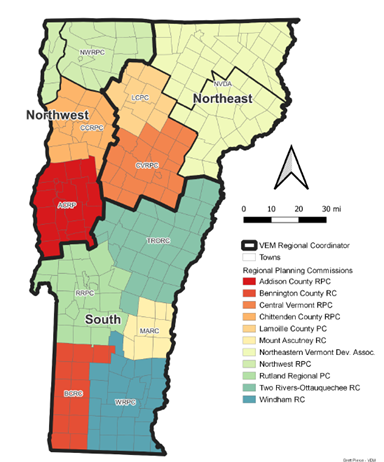
Note: Franklin County REMC and Grand Isle REMC are two distinct REMCs.
Go-To Info for Municipalities
Things your community should have:
-
Appoint an Emergency Management Director, Coordinator, or both.
-
Update the Local Emergency Management Plan (LEMP) every year.
-
Complete a Local Hazard Mitigation Plan every five years.
-
Adopt river corridor protection in land use bylaws and in municipal plans.
-
Identify a local shelter for your community. Have written agreements in place with shelter partners. Keep supplies on site (bottled water, first aid kit, extra toilet paper, sanitation supplies). Check supplies and agreements annually.
-
Put an emergency preparedness line item in the town budget (to pay for things like the stash of toilet paper, sandbags, or gas for the generator).
-
Have mutual aid MOUs in place before they are needed. Review them annually.
-
Engage residents! Use tools like Front Porch Forum, or a town newsletter to remind neighbors about shelter locations, family preparedness, and to keep them apprised of what your community is doing to be better prepared.
- Watch training video Authorizing Emergency In Stream Work in Accordance with Vermont Law.
Share Information
Sometimes the state will “activate” the Regional Planning Commissions if the state believes there could be a widespread impact from an event. RPCs then reach out to each municipality to collect local situation reports. We attempt to contact the people listed on your Local Emergency Operations Plan using a combination of VT-Alert, email, and phone. We send your municipality’s information to Vermont Emergency Management. The state uses the information to direct resources to the areas that need it most and to determine if Vermont qualifies for a disaster declaration.
Document, Document, Document
It’s important to document everything that you can during an event. Take pictures! Use a computer or a notebook to record the work done during response and recovery. Take more pictures! Record expenditures, staff and volunteer time during response and recovery. Save time cards and receipts.
-
Example: “April 29, 2014: Janet Jones, resident volunteer, cut and removed fallen tree limbs on Main Street from noon to 4:00 p.m. using the town’s chainsaw to clear the right-of-way for emergency vehicles.”
For more information on emergency planning, please contact Shaun Coleman by email or at (802) 524-5958.